
LTS project
how schooling was reorganised around leadership theory
(image: adam bongers)
The Leadership Theory in Schooling (LTS) project diagnosed and accounted for the ‘leaderisation’ of schooling.
The ‘leaderisation’ of schooling: The transition from administrative theory to leadership theory as the main way of organising education in English-speaking countries. It has reorganised how professional practice is conducted and how expert knowledge is produced.
The project found that leaderisation was not a straightforward case of the ‘best’ theory inevitably winning, or simply due to political and economic pressures. Instead, the project found that schooling was reorganised around leadership theory, in no small part, because of its affinity with survey research designs.
This combination of leadership theory and survey questionnaires promised productive and consistent evidence for evidence-based practice. However, this promise came at the expense of known concerns about the validity of relying on such research.
These concerns are still live, because contemporary leadership models come packaged with survey instruments, and rest on survey studies that are continually reproduced in meta-reviews. This project suggested that early research design choices have limited what we want to know, and narrowed our sense of what schooling can be.
The project recommends a more ‘anarchic’ and ‘pluralistic’ approach along multiple lines to develop better theory, whether that means better leadership theory, or something better than leadership.
Key features:
- A detailed intellectual history. Traces over 60 years of English-language theory and research in educational administration and leadership.
- An integrated narrative. Makes sense of leadership theory, models, and research at a time when school leadership research continues to proliferate.
- A radical return to fundamental questions. Challenges assumptions about ‘school leadership’ by accounting for how schooling became linked with leadership theory.
- An original approach. Connects histories of leadership theory and survey design to reveal how surveys reshaped education research priorities.
- A proof of concept. Demonstrates the value of theory-driven inquiry for generating new directions in understanding and improving schooling.
Research Outputs:
- Bongers, A. (2025). The leaderisation of schools: how did schooling come to be about leadership? [Commentary]. Leading & Managing, 31(3), 135-9. https://journals.flvc.org/leading-and-managing/issue/view/6569
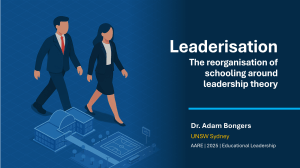
- Bongers, A. (2025, December 3). Leaderisation: The reorganisation of schooling around leadership theory [Paper presentation]. AARE Annual Conference, Newcastle, Australia.
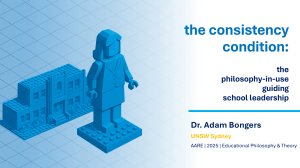
- Bongers, A. (2025, December 3). The consistency condition: The philosophy-in-use guiding school leadership [Paper presentation]. AARE Annual Conference, Newcastle, Australia.
- Bongers, A. (2025). Leaderisation: How leadership thinking changed the way knowledge is produced about schools (Doctoral dissertation, University of New South Wales). https://doi.org/10.26190/unsworks/31375
- Bongers, A. (2024, December 5). Knowledge about educational leadership: Leadership as a thought-system that was imported into school discourse [Paper presentation]. AARE Annual Conference, Sydney, Australia.
- Bongers, A. (2022, December 10). A Problem of leadership [Paper presentation]. PESA Annual Conference, Sydney, Australia.
 Adam Bongers